

The Biotech Breakout
Healthcare struck back. Now its most aggressive corner is igniting — and the best way to own the AI-in-biology boom carries no drug-failure risk at all.

«The tape knows first.»
After Jesse Livermore, speculator (1877–1940)
In January, we wrote that healthcare was striking back — that our favourite sector, after five years in the wilderness, was turning from laggard to leader. Quietly, breadth improving before the headlines.
The headlines have now caught up. And the move has found its sharp end.
Biotech — the most volatile, most hated, most aggressive corner of healthcare — is breaking out. Not drifting. Breaking. The blue-chip biotech index is at fresh all-time highs. The high-beta genomics names are erupting out of one of the cleanest multi-year bases you will ever see. And a single, founder-led company sits at the centre of it all — one we have written about before, one that profits whether any given drug succeeds or fails.
This piece is about three things: why a new all-time high is the most bullish signal in markets, why biotech is one of the largest and least-understood beneficiaries of artificial intelligence, and how we would own all of it — without betting the farm on any single molecule.
Listen to the tape.
The Most Bullish Signal Is the Simplest One
New all-time highs.
Look at biotech. The iShares Biotechnology ETF, IBB, has just pushed to fresh all-time highs — clearing the peak it set earlier this year and, before that, a high that had stood since the 2021 mania. Years of damage, a deep multi-year base, and now a clean break to the highest level the fund has ever traded. Most people see a new high and think «too late». The opposite is true — and the reason is psychology, not mathematics.
Psychology drives more than half of long-term investing results. Probably more. And nothing shifts psychology like a new high.
Here is why owning a stock at all-time highs is an edge: there is no overhead supply. No trapped buyer from a higher price, waiting to get back to break-even so they can sell. When a chart is at all-time highs, everyone who owns it is sitting on a profit. Which means everyone holding it is validated, comfortable, and willing to let the winner run. The line of least resistance points up — because there is no one left above the price who needs to sell.
Think about your own portfolio. When a position makes a new high, you are not stressed. You are not refreshing the quote every hour. You are not second-guessing. Uncertainty is low — and uncertainty is the one thing investors hate most.
That creates a reinforcing loop. Happy holders, no selling pressure, an easier path up, new highs, happier holders.
That is why a new all-time high is the most bullish signal in technical analysis. Not magic. Not a formula. Just human behaviour, doing what it always does.
Chart 1: The iShares Biotechnology ETF (IBB), weekly — fresh all-time highs after a multi-year base.
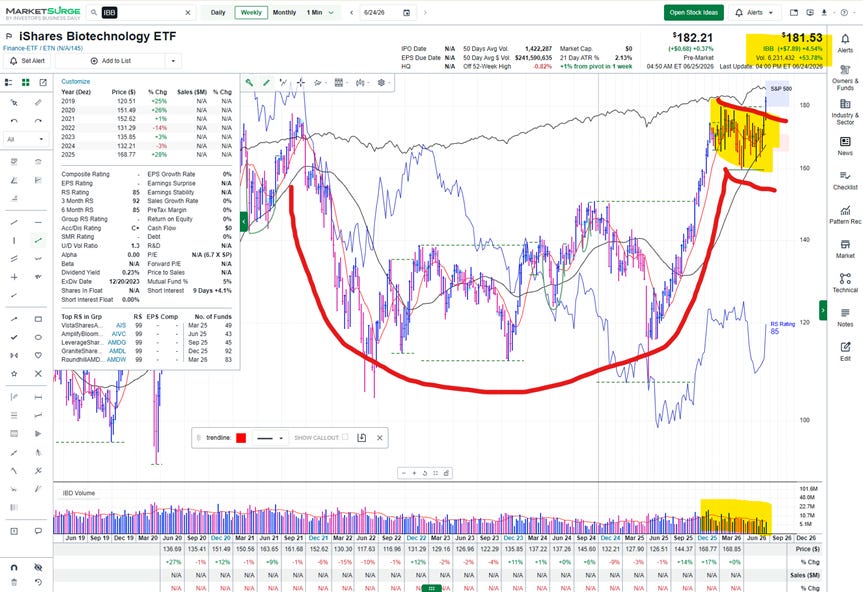
IBB weekly — breakout to new highs
IBB is the blue-chip version of this trade — the large, established biotech and biopharma names, the steadier way in. But there is a younger, wilder cousin. And its chart is even more interesting.
The «J Lo Bottom» — Genomics Wakes Up
Now we have to talk about a chart pattern with an unfortunate name.
A trader named Stewie — @traderstewie on X, who has been preaching «price and volume is all you need» since 2009 — coined it years ago: the «J Lo bottom». The description is exactly what it sounds like: a long, deep, rounded base with a little upward curve at the end before it launches. Crude name. Real pattern. (If you do not see it, just picture the silhouette.)
Look at ARKG, the ARK Genomic Revolution ETF.
Chart 2: The ARK Genomic Revolution ETF (ARKG), weekly — a multi-year rounded base, breaking its downtrend.
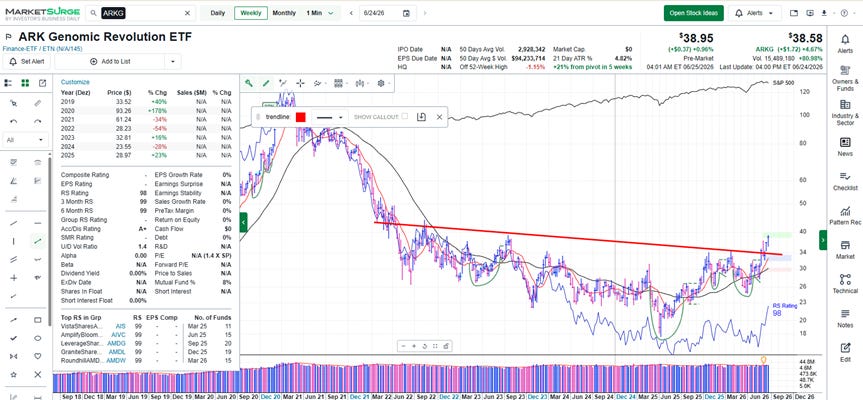
ARKG weekly — rounded base breakout
After being destroyed in the 2021 mania — down more than 70% — ARKG spent years carving one of the cleanest rounded bases you will ever see. A long, patient curve along the bottom, then a higher low, and now a breakout through the multi-year downtrend line on rising volume.
It is the same story as IBB hitting new highs — just younger, and far more aggressive. IBB is the blue-chip. ARKG is the high-beta cousin: the genomics and gene-editing names that fall the hardest and rip the hardest.
And the technicals behind the joke are deadly serious. A multi-year rounded base means every panicked seller is long gone. The overhead supply is exhausted. When price finally clears the downtrend, there is almost no one left to sell into the move. The deeper the base, the bigger the launch — and this base is deep.
Crude name. Textbook setup.
Why This Is an AI Story
Here is the part the technical charts do not tell you, and the part we think the market still underprices.
Biology is, at its core, a data problem.
A genome is three billion base pairs. A clinical trial generates oceans of patient data. Drug discovery means searching a chemical space larger than the number of atoms in the universe for the handful of molecules that work. For decades, this was done slowly, by hand, by intuition, at a median cost approaching a billion dollars and timelines of ten to fifteen years per drug.
This is precisely the kind of problem artificial intelligence was built to attack. Pattern-finding across vast, high-dimensional data — protein folding, target identification, trial design, patient selection, genomic analysis. The same compute boom powering the semiconductor parabola is now being pointed at biology, and biology is one of the richest data substrates on Earth.
Data, data, data. That is the fuel. And genomics sits on the largest reservoir of it.
This is why we think genomics and biotech are among the biggest — and least-appreciated — beneficiaries of the AI era. Everyone sees the chips. Far fewer see that the most profound application of all that compute may not be chatbots, but the industrialisation of drug discovery. The breakout on the chart and the breakthrough in the lab are, we believe, the same story.
So: a sector breaking to new highs, a high-beta cousin erupting from a generational base, and a genuine AI tailwind underneath both. The question is how to own it.
And here our discipline kicks in — because biotech is also where investors get destroyed.
The Problem With Owning Biotech
Individual biotech stocks are binary bets.
A single company can spend a decade and a billion dollars chasing one drug. The trial reads out — and the stock doubles, or it falls off a cliff. Overnight. We watched Novo Nordisk, a quality compounder, lose a fortune of market value on disappointing trial data. That is the nature of the beast: brilliant science, terrible risk profile, outcomes that hinge on a single binary event no analyst can handicap.
So our view is simple, and it is the heart of this piece. We do not play single biotech stocks. The drug-failure risk is exactly the kind of un-handicappable, all-or-nothing bet we avoid.
For the sector and the genomics theme, we own the ETFs — IBB for the blue-chip exposure, ARKG for the high-beta genomics breakout. Diversification across dozens of names means no single failed trial can sink the position. You own the theme — the funding rebound, the AI tailwind, the sector re-rating — without the single-molecule lottery.
But there is one company that lets you own the entire biotech boom and sidesteps the drug-failure risk entirely. Not through diversification. Through its business model.
It is the best risk-reward in the whole complex. And it is the real reason we are writing today.
