


I run real money in global quality stocks (we are a team of 4, I am the voice), and I write about the things I spend my days thinking about: great businesses, the cycles they live through, the psychology that trips investors up, and the long, quiet game of building wealth by owning the best companies in the world and holding them.
I’ve been doing this for years — for The Market (NZZ), every week here, and across everything I read. This page is a map to all of it.
How I think: Good Story & Good Chart
Before the topics, the method — because it’s what makes everything else make sense.
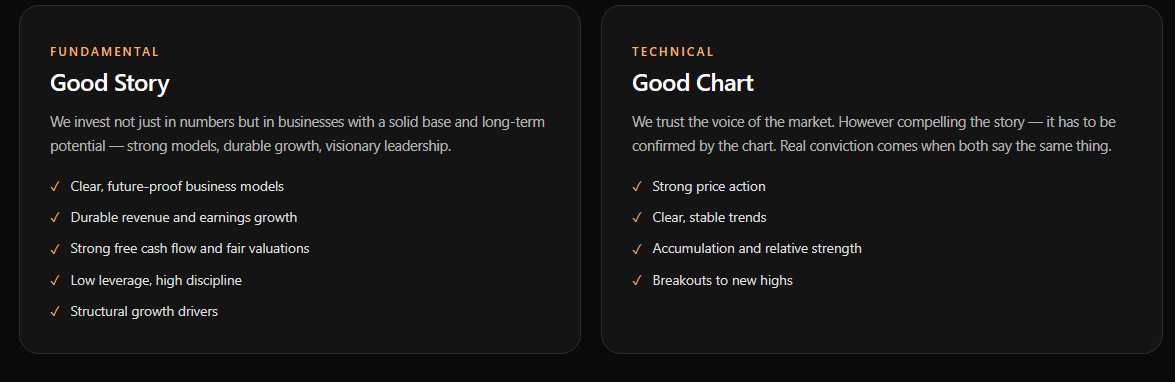
Most investors pick a side. The fundamental crowd studies the business and ignores the price. The technical crowd studies the price and ignores the business. I think that’s a false choice, and an expensive one. So I look at both.
A “Good Story” is the business itself: a real moat, high returns on capital, sustainable growth, sensible management, a structural tailwind. A company built to compound for decades, not quarters.
A “Good Chart” is the market agreeing over time — the price structure, the trend, the relative strength that tells you the world has noticed what you noticed.
You want both. A good story with a bad chart is a value trap: you’re right about the business and the market never shows up, sometimes for years. A good chart with a bad story is a bubble waiting to pop. But a great business the market also respects — that’s where the real compounding happens, and where the risk is lowest. This is my whole framework, Good Story & Good Chart®, and almost everything I write is an application of it.
The philosophy underneath it is simple: buy great businesses, don’t overpay, and hold them for a long time — while keeping the trend working in your favor instead of against it.
What I write about
arvy’s Weekly. Friday’s “easy read”. Every week: what moved markets, what actually matters for long-term owners, and one idea worth carrying into the week. Five minutes, no predictions, no noise.
Companies & Sectors. Full breakdowns of individual businesses and the industries they live in — the moat, the economics, the risks, and what the chart says. The same work I do before real capital goes anywhere.
Market Cycles & Macro. Where we are in the cycle and what’s happening beneath the headlines. Seasonality, liquidity, market internals, and the historical parallels that tell you what usually comes next.
Lessons & Psychology. The timeless stuff — what the great investors actually did, the frameworks that hold up over decades, and the psychology that separates good returns from great ones.
Book Club. I love reading, and I’m convinced that twenty francs spent on the right old book is the best money an investor can spend — a lifetime of someone’s hard-won wisdom for the price of lunch. So I share what I’m reading and why: the books that shaped how I think about business, markets, and life.
How the week usually works
So you know what to expect in your inbox:
Tuesday — the heavy piece. A company or sector, taken fully apart.
Friday — arvy’s Weekly. The easy read.
Sunday — a lesson, a framework, or a piece of market psychology.
Plus ad-hoc research and thoughts, the monthly screening drop, and near-daily thoughts on Notes and X.
What this isn’t
It isn’t a stock-tip service. I don’t send hot picks, and I’d be suspicious of anyone who does. What I try to do instead is make you a sharper investor — someone who can spot a great business, sit through the noise, and hold it long enough to let it work. That compounds far longer than any single idea.
Most-Read Articles
Would you like to read some popular articles to get an overview?


How it works
A great part of what I write is free — the weekly posts, the thinking, the books — and always will be. Subscribe for free and read along.
For readers who want to go deeper, there is a paid side. And its heart is a tool.
The Screening: the tool that argues with you
Every call we make at arvy runs through one engine: the screening. 800+ of the world’s finest businesses and 300+ ETFs, each scored week after week on the two questions that decide everything — is this a great business, and does Mr. Market agree?
Good Story. Good Chart.
Both, or nothing.
A confession about what it is really for. The most valuable thing the screening has ever done for us is not the ideas it surfaced. It is the love stories it ended.
For seven years, Wolters Kluwer and RELX were among the best businesses we owned. Dividend aristocrats. Fundamentals above 90 — elite territory. Then, through 2025, the Chart scores collapsed toward 30 while the Story scores stayed perfect. Two businesses we loved, being systematically distributed. We honoured the tape and sold out in October 2025. From their highs, both now trade roughly 70% lower — and the fundamentals still have not materially changed. That single pair of decisions repaid a lifetime of subscriptions. It is exactly the kind of decision the tool exists to force.
So the screening is not a tip sheet. It is a sober second opinion that sits next to every conviction you have — including, and especially, your own portfolio. Run your holdings through it and let it argue with you.
Two pieces show you everything:
The Screening (Stocks & ETFs) — what the tool is: the philosophy, the five screens, and how to get in.
How to Actually Use the arvy Screening — the field manual: the workflows we run at arvy every week, the Veeva and Wolters Kluwer case studies, and your first 15 minutes inside the tool.
What the paid side includes
The full screening — 800+ quality stocks and 300+ ETFs across asset classes, regions, sectors and thematics, scored on Good Story & Good Chart®, refreshed at minimum monthly.
The live arvy portfolio — the roughly 30 businesses we actually own, sitting next to the engine that generates them.
Members-only deep dives — the framework applied to what is actually happening in markets: the cycles, the sectors, the businesses worth understanding.
Run the arithmetic: a standalone screening platform costs $40–100+ a month elsewhere, with no research, no portfolio, no decade of applied methodology behind the scores. Here, it is all one product — $34 a month, or $340 a year — and every subscription starts with a seven-day free trial. Enough time to run your entire portfolio through the tool and let it argue with you once.
No tips — just the research, the discipline, and the judgment, in full.
Either way, welcome. I’m glad you’re here.
— Thierry and team arvy