


What if the secret to finding winners was not to chase net profits, but to focus on sales growth? Steve Jobs’ 1997 mantra turned Apple around – and it’s a principle that every investor needs to understand to find the next compounder.
«If you do the right things on the top line, the bottom line will follow.»
Steve Jobs, co-founder of Apple (1955–2011; in an interview in 1997)
Original post here: NZZ The MarketThis quote is etched in my memory.
It underscores a simple but powerful truth: the top line is the engine that drives everything else.
Few moments in business history illustrate this as vividly as Apple in 1997. At the time, the company was teetering on the edge of bankruptcy when Steve Jobs returned. In an interview, he laid out his turnaround strategy with this remarkable insight:
«Somebody taught me a long time ago a very valuable lesson which is: if you do the right things on the top line, the bottom line will follow. And what they meant by that was: if you get the right strategy, if you have the right people, and if you have the right culture at your company, you’ll do the right products. You’ll do the right marketing. You’ll do the right things logistically and in manufacturing and distribution. And if you do all those things right, the bottom line will follow.»Steve Jobs’ 1997 mantra turned Apple around – and it’s a principle that every investor needs to understand to find the next compounder. Add to that one of the most powerful financial levers associated with this concept. A metric that can supercharge stock prices over the long term:
Profit margin improvements.
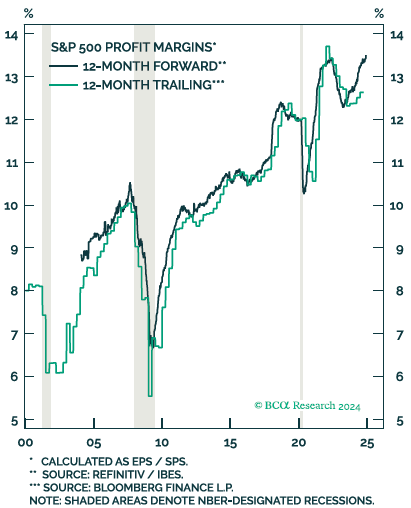
Chart 1: Uptrend in the profit margins of the S&P 500
The Sweet Spot of the Business Growth Cycle
The post-Global Financial Crisis era has been defined by significant margin expansion. The rise of the «Magnificent 7» and other asset-light business models – Adobe 2013 as a pioneer of the software subscription model – are illustrative of this trend. But the story behind it is simple math, a formula that every bottom-up stock picker knows well. Why have these companies managed to improve their profit margins so much?
It is where the business growth cycle comes into play.
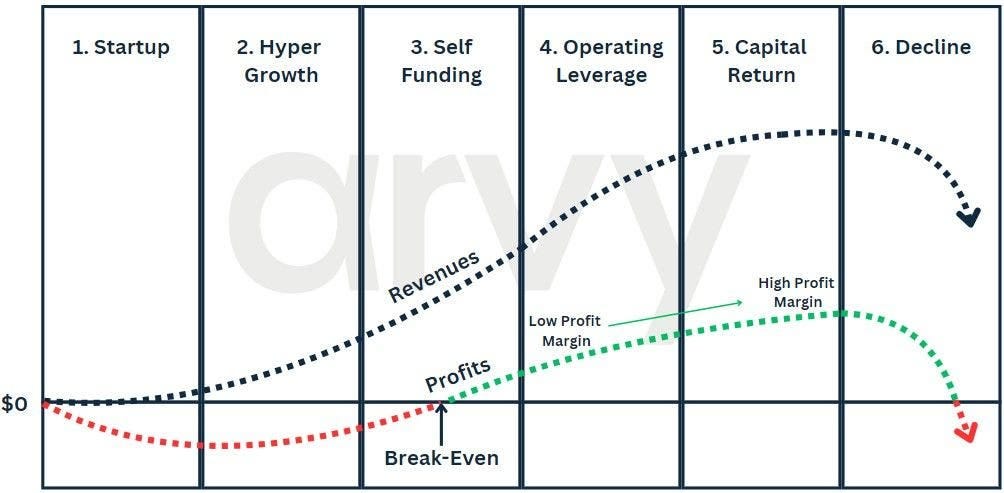
Look at the second half of the «Self-Funding» stage through to the «Capital Return» stage (see chart 2). This is the «sweet spot» where profit margins start to increase and allow for stable, predictable growth. This is where you find companies that consistently generate double-digit returns over the long term. This is where you will find compounders.
Chart 2: The six stages of the business growth cycle
I focus on these areas because businesses in the earlier, «Hyper Growth» stage often bring higher volatility and uncertainty. While companies like Palantir might excite some investors with lofty potential, they don’t yet have the earnings stability or visibility needed for consistently high long-term returns.
I simply like to focus on the boring stuff – because boring is good. I won’t be one of the cool guys at the bar talking about their home run stocks while draining multiple pitchers, but I’ll be the one who wakes up without a headache because I just enjoyed a quality gin. And I’ll be able to get back on the mat the next day and play the long game in investing – because that’s really what it’s all about.
Thus, I look for businesses in the latter part of «Self-Funding», where growth is self-sustaining, and margins improve steadily. These companies tend to exhibit high returns on invested capital (ROIC), strong revenue and earnings stability, and predictable cash flows.
This «sweet spot» is where the magic happens.
It is no surprise that the greatest potential lies in the early stages of a company’s profitability: the break-even point. This is usually when business momentum accelerates dramatically, fundamentals improve significantly, and management excellence is at its best.
One of the clearest examples of this principle is another Magnificent 7 stock: Amazon.
Sales Growth Drives Stock Performance
For years, skeptics dismissed Amazon, arguing that its price-to-earnings (PE) ratio was too high. However, the stock kept moving higher, fueled by one thing: revenue growth, the top-line. The company’s relentless sales growth proved to be the ultimate driver of long-term shareholder returns.
And as we’ll see, Amazon didn’t just experience top-line growth; it also achieved significant profit margin improvements, which were key to its long-term stock performance.
Chart 3: Sales Growth is Key Driver of Long-Term Stock Performance. Sources of Total Shareholder Return for Top-Quartile Performers, S&P 500 (1990 – 2009)
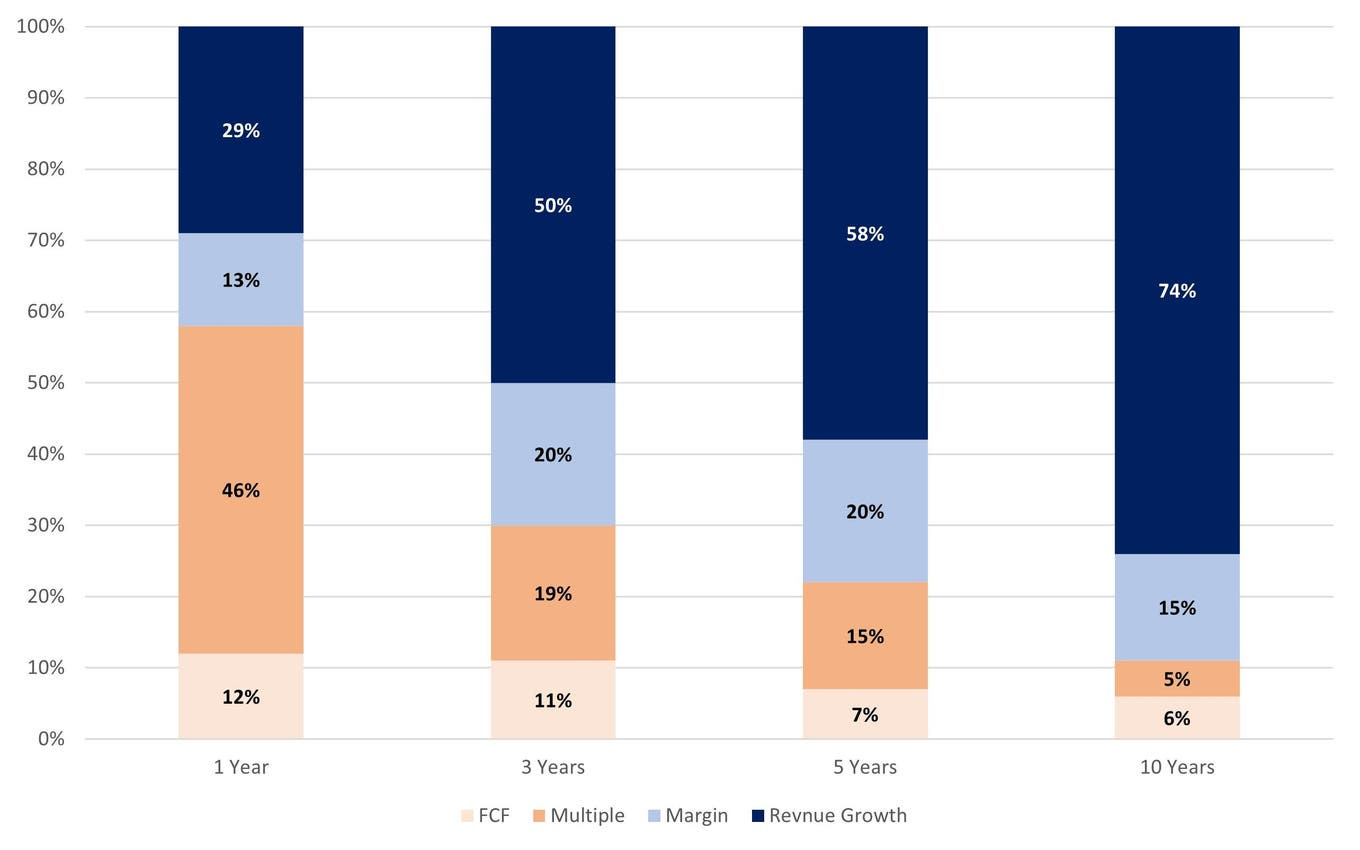
The study above – and Amazon’s history – are poster children for Steve Jobs’ wisdom: «If you do the right things on the top line, the bottom line will follow.» It shows the importance of revenue growth and explains why such success happens for a business. Something must be coiling. Some cylinders must be firing. Something is simply happening that should not only pique our curiosity but also demand our attention. Then, the business moves from «Hyper Growth» to «Self-Funding», and we need to study why.
Let’s look at Amazon to find typical catalysts and what moves stock prices. For Jeff Bezos, it was the launch of a new product – Amazon Web Services, in short AWS – in 2006. A «new product» can be powerful.
AWS is a prime example of how a single new product can redefine a company’s path.
1. Initial Adoption and Revenue Growth
(Stage 2: Hyper Growth, 2006–2010):
AWS started as a small part of Amazon’s operations but grew steadily by attracting startups like Netflix, Airbnb, and Dropbox, which relied on its scalable infrastructure.
By 2010, AWS achieved $500 million in annual revenue, marking its early signs of success.
2. Turning Point in Importance (Stage 3: Self-Funding, 2010–2014):
By 2014, AWS hit $5 billion in annual revenue, and its growth rate far outpaced the rest of Amazon’s e-commerce business.
Amazon’s quarterly earnings began showing AWS as a separate line item in Q1 2015, revealing its profitability for the first time.
3. AWS as a Growth Driver (Stage 4: Operating Leverage, 2015–Present):
In 2015, AWS posted $7.88 billion in revenue with an operating margin over 25%, a stark contrast to Amazon’s thin margins in retail.
By 2023, AWS was responsible for nearly 16% of Amazon’s total revenue and a staggering 70% of its operating income.
AWS helped Amazon finance its other ventures, including logistics, Prime Video, and Alexa, while solidifying its leadership in the cloud computing market.
Chart 4: Amazon’s annual revenue/net income with inflection points 2006, 2010 & 2015, linear scale
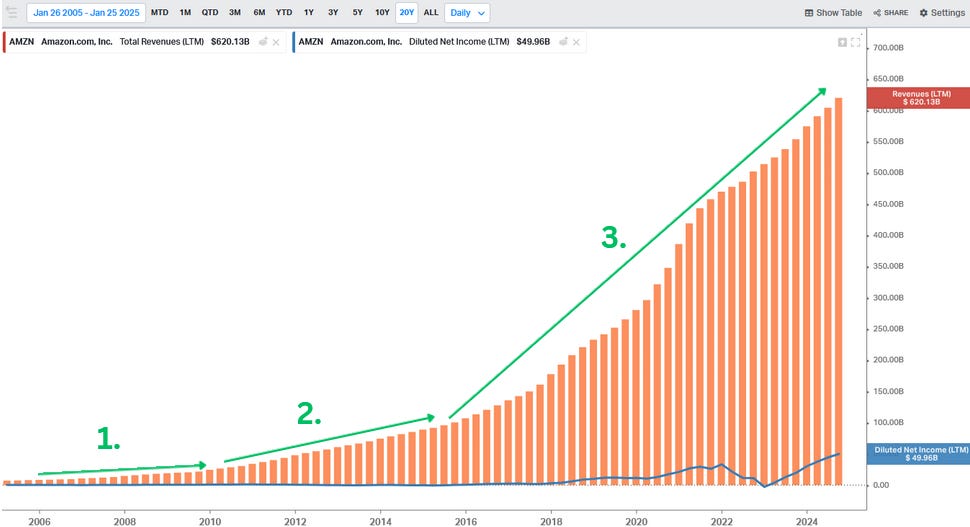
The step-by-step adoption of AWS fundamentally altered Amazon’s financial trajectory. It evolved from an expensive investment («Hyper Growth») into Amazon’s most profitable division («Operating Leverage»). It allowed the company to balance its low-margin retail operations with a high-margin tech business.
Today, AWS is the linchpin of Amazon’s bottom line, driving sustained profitability and funding innovation across its global empire. A stock with significant top-line growth suddenly became a stock with bottom-line growth.
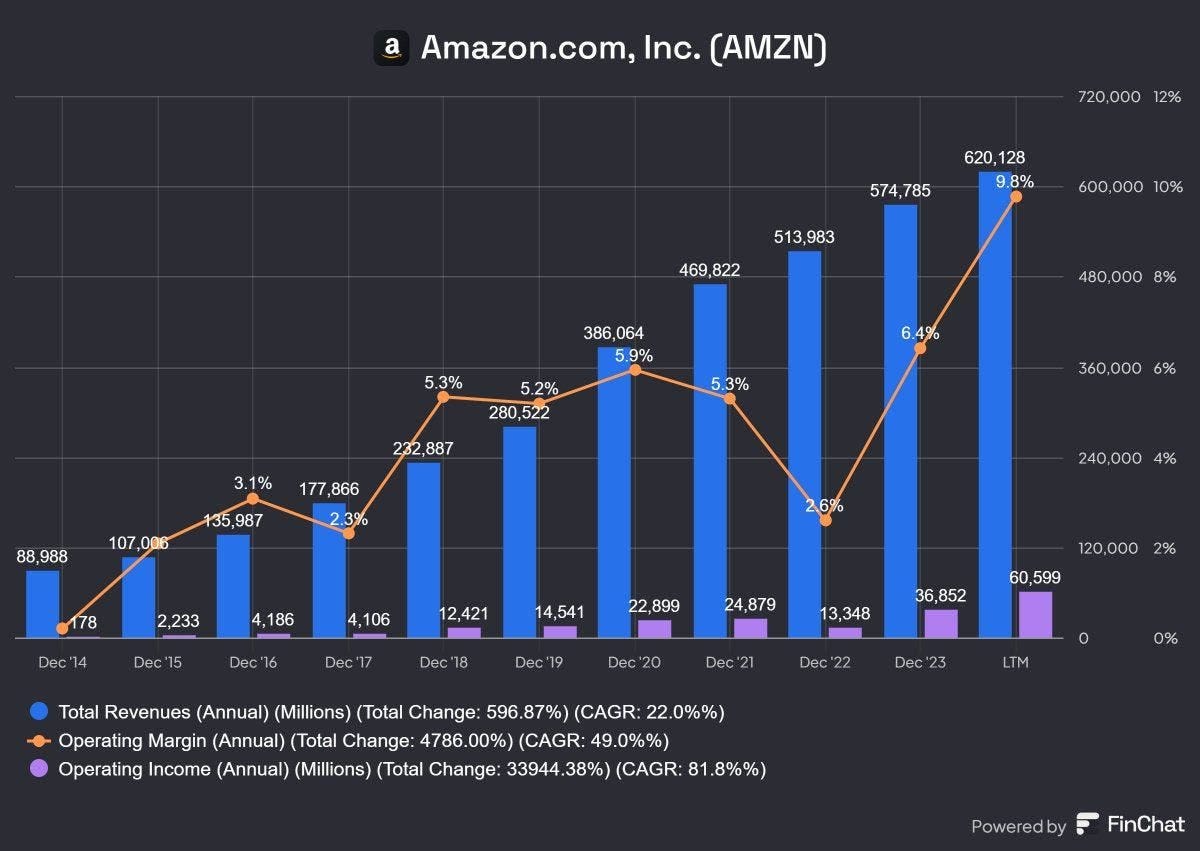
Stage 4, «Operating leverage», marked the point at which the margin improvement reached its full potential. It is considered the second important tipping point after reaching break-even. The concept is relatively straightforward and primarily tied to fixed costs. As revenue increases, fixed costs remain constant, leading to significant improvements in profit margins (see chart 5).
For example, if your revenue doubles from $1 million to $2 million while your fixed costs stay fixed at $500,000, your margin related to fixed costs increases from 50% to 75%. At $10 million in revenue, the margin rises to an impressive 95%.
This dynamic highlights the critical role of fixed-cost structures in driving margin expansion. It’s also a decisive factor in stock price development and demonstrates why asset-light business models have been key contributors to the profit margin improvement of the S&P 500.
Chart 5: Amazon Total Revenues, Operating Margin and Income
Study the past
I acknowledge that I’ve cherry-picked a standout success story, but this is what investing is all about: studying past winners that continue to thrive.
In fact, the story of Amazon’s AWS parallels what happened with Apple in 2007 when Steve Jobs introduced the iPhone. Just like AWS transformed Amazon, the iPhone played a similar role for Apple: kick-starting their growth engine, driving significant top-line expansion, and ultimately leading to remarkable bottom-line growth and margin improvements. The remarkable evolution of both companies’ stock prices speaks for itself.
Concluding about improving profit margins and the Magnificent 7, we must be aware that we are approaching the next-to-last level of «Capital Return» for these businesses. This is reflected in a 15-year upward trend in profit margins (see again chart 1 above) and the highest expectations of these.
I touched upon this problem last October. The market’s over-reliance on a few giants is skewing risk-reward dynamics, squeezing your margin of safety to a razor-thin line. Peak expectations, as analysts put it.
It is therefore time to look for other companies that are not as far along in the growth cycle and, more importantly, not as gigantic. These companies have an easier time growing, and with Apple and Amazon’s playbook, we know what to look for.
What to look for
We will repeatedly find businesses capable of making a difference, and they often exhibit similar characteristics to Apple and Amazon.
Some examples that, in my view, fit this description today are MercadoLibre, Coupang, Sea Limited, Shopify and HubSpot, as they are all transitioning to high-margin scalability by expanding beyond their core businesses into fintech, AI-driven automation, and advertising, unlocking new revenue streams and driving the next phase of exponential growth. Another great example is Nintendo, which is moving beyond traditional console cycles by aggressively monetizing its legendary IP (e.g. Mario, Zelda, Pokémon) across multiple platforms.
These companies usually launch a new product that brings profitability and attractive growth rates, guided by a strong CEO and management team with the skills, integrity, and discipline to build something lasting. While a new product can emerge at any stage, it is most impactful if the company introduces it in Stage 3 («Self-Funding») of the business growth cycle.
At this stage, businesses begin to improve their profit margins, reducing the risk of permanent capital loss, while entering the highest risk/reward phase. This is where we find the most attractive companies to own for the long run. Much like Apple’s phoenix moment, rising from the ashes with the iPhone and really getting back on the road to success, or Amazon becoming truly profitable with the widespread adoption of AWS. By holding these businesses from «Self-Funding» through «Operating Leverage» and «Capital Return», we maximize our compounder potential.
In short, Steve Jobs gave us a timeless lesson in 1997 – one validated by the journeys of Apple and Amazon:
Focus on the top line. The bottom line will follow.
Wow. what an awesome read! Thanks so much for the in-depth view and your thoughts.